Why are LLMs so good at translation?
Anyone who used machine translation fifteen years ago remembers what it felt like. You pasted in a sentence and got back something that was technically readable and occasionally hilarious, a string of words that had clearly never met each other before. Today, large language models produce translations that read as though a careful person wrote them, with the right tone, the right idioms, and the rhythm of the target language. Something dramatic happened in between, and it is worth understanding, because the story explains not just why modern translation works so well, but also why it sometimes fails in ways that are hard to spot.
Here is the strange part: nobody ever sat down and taught these models to translate. There were no vocabulary drills, no grammar lessons, no bilingual flashcards. The ability simply appeared as the models grew large enough, which makes the question in the title of this article more interesting than it first looks. The answer comes in three acts: a bottleneck, a breakthrough, and an accident.
The memory bottleneck
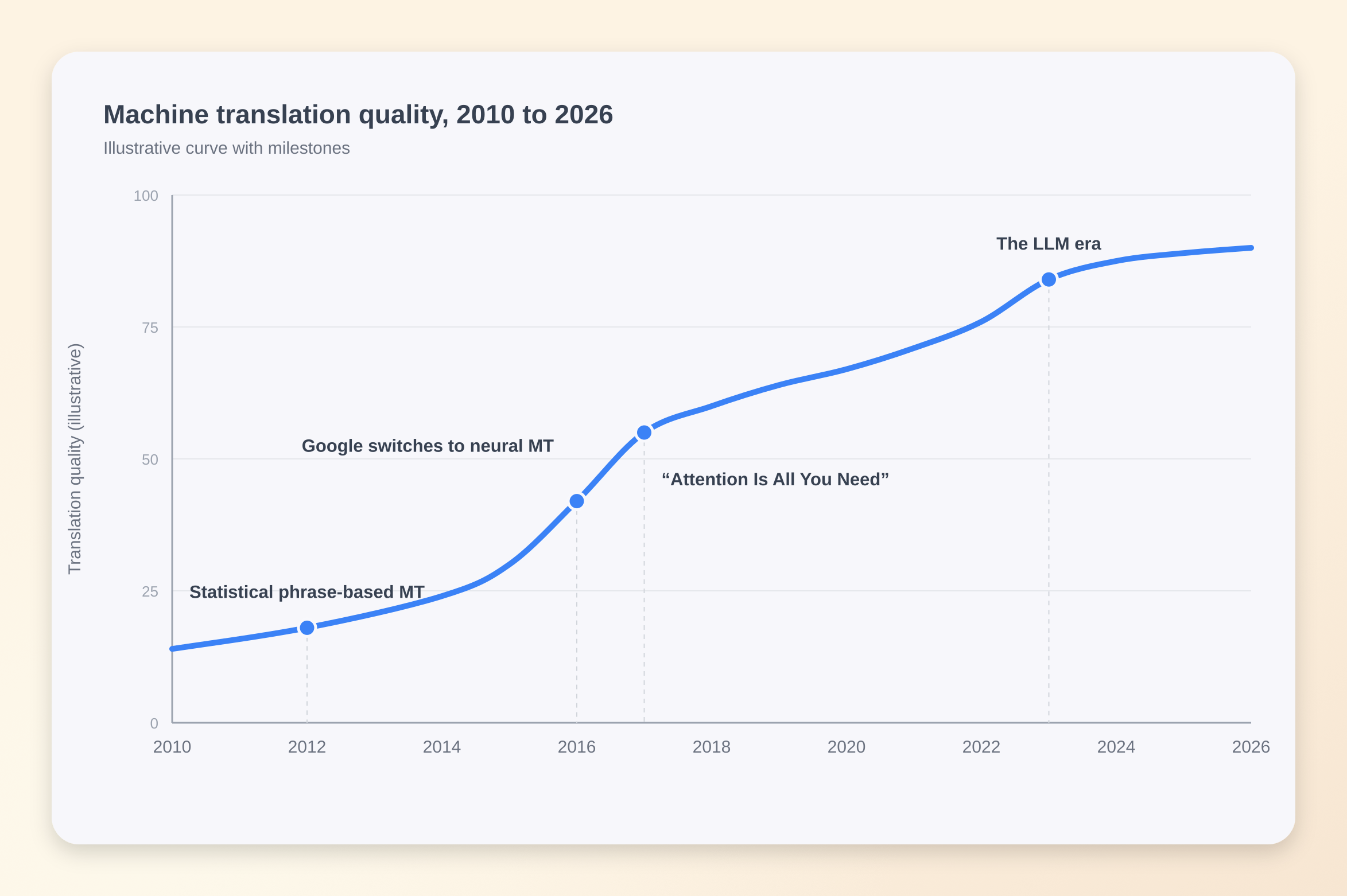
The first practical machine translation systems were essentially giant phrasebooks. Statistical machine translation, which powered Google Translate for its first decade, chopped sentences into fragments and looked each fragment up in enormous tables of text that humans had translated before. If your sentence resembled something in the tables, the result could be decent. If it did not, if it contained a rare word or a long and winding structure, the system stumbled, because it had no real model of the sentence as a whole. It knew how pieces of sentences tended to be translated. It did not know what the sentence meant.
In 2014, a team led by Ilya Sutskever introduced a genuinely different approach, now known as sequence-to-sequence learning. One neural network, the encoder, reads the entire source sentence and compresses it into a single fixed-size numerical summary, a kind of distilled thought. A second network, the decoder, unpacks that summary and writes the translation one word at a time. For the first time, machines were translating from meaning rather than from phrase tables, and quality jumped. Google switched its translation service to this neural approach in 2016.
But the design carried two flaws that researchers could not engineer away. The first was the summary itself: squeezing an entire sentence into one fixed-size thought is like asking a friend to compress a paragraph into ten words and then translate from the compression. Long sentences lost their beginnings before their ends were reached. The second flaw was speed. Reading and writing word by word, in strict sequence, meant the models could not be trained in parallel, which put a ceiling on how large they could grow. Another 2014 paper, by Dzmitry Bahdanau and colleagues, offered a partial fix with an idea called attention: instead of relying only on the summary, the decoder was allowed to glance back at the original sentence and focus on whichever words mattered most at each step. Attention worked remarkably well. Within three years, it would turn out to be the whole game.
The 2017 breakthrough
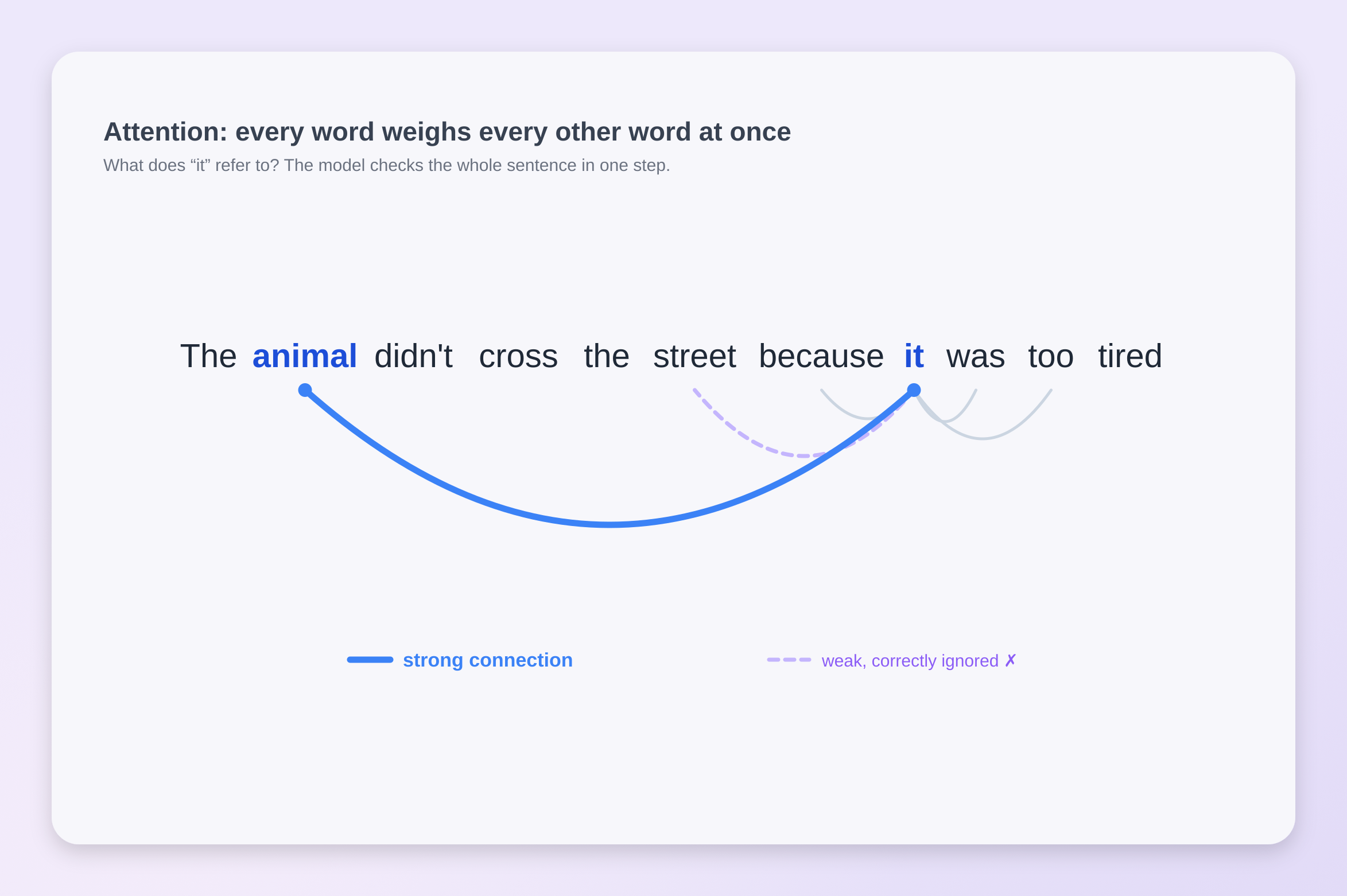
In 2017, eight researchers at Google published a paper with a title that has since become a slogan: Attention Is All You Need. Their proposal was radical in its simplicity. If glancing back at the sentence works so well, why read sequentially at all? Their new architecture, the transformer, threw out the word-by-word conveyor belt entirely. Instead, every word in a sentence looks directly at every other word, all at once, and decides which ones matter for understanding it.
Consider what that buys you. In the sentence "The animal didn't cross the street because it was too tired," figuring out what "it" refers to requires connecting a pronoun to a noun several words away, while ignoring a tempting wrong answer, "street," that sits closer. A sequential model passes this problem down a chain of memory cells and hopes nothing gets lost. A transformer solves it in a single step, because "it" can attend straight back to "animal" no matter how far apart they sit. Better still, the model does this with many attention heads working in parallel, each one sensitive to a different kind of relationship: one tracks grammar, another meaning, another references, like a room full of readers each watching for something different. A mathematical trick called positional encoding keeps track of word order, so the system knows not just which words are present but where they stand.
The practical consequences were enormous. Because every word is processed simultaneously rather than in sequence, training could be spread across thousands of chips working in parallel, and models grew from millions of parameters to hundreds of billions. On the standard WMT 2014 translation benchmarks, the original transformer already beat the best existing systems by more than two BLEU points, a large margin in a field where progress usually comes in fractions. And the architecture proved general-purpose: BERT, GPT, T5, and every large language model since is, at heart, a transformer.
Try Fink for your next translation
See the translation, every change, and the why on one screen.
Open AppThe accident: translation nobody trained
This is where the story takes its strangest turn. Modern large language models are trained on exactly one task: predict the next word in a text. They see half a sentence and guess what comes next, billions upon billions of times, across hundreds of billions of words of books, articles, and websites. Nobody hands them pairs of translated sentences to study. Nobody defines translation as a task at all.
Yet the training data holds a quiet secret. It is mostly English, but a meaningful slice of it, a few percent, is written in other languages, and scattered throughout are pages that mention two languages at once: a quote in French with its English rendering, a manual in parallel German, a forum post that switches between Spanish and English mid-sentence. These incidental bilingual signals, multiplied by a training set the size of a library, were enough. At a certain scale, translation ability appeared, abruptly, in models that had never been asked for it. Researchers call this an emergent capability, and translation is its classic example, documented across systematic surveys of multilingual models.
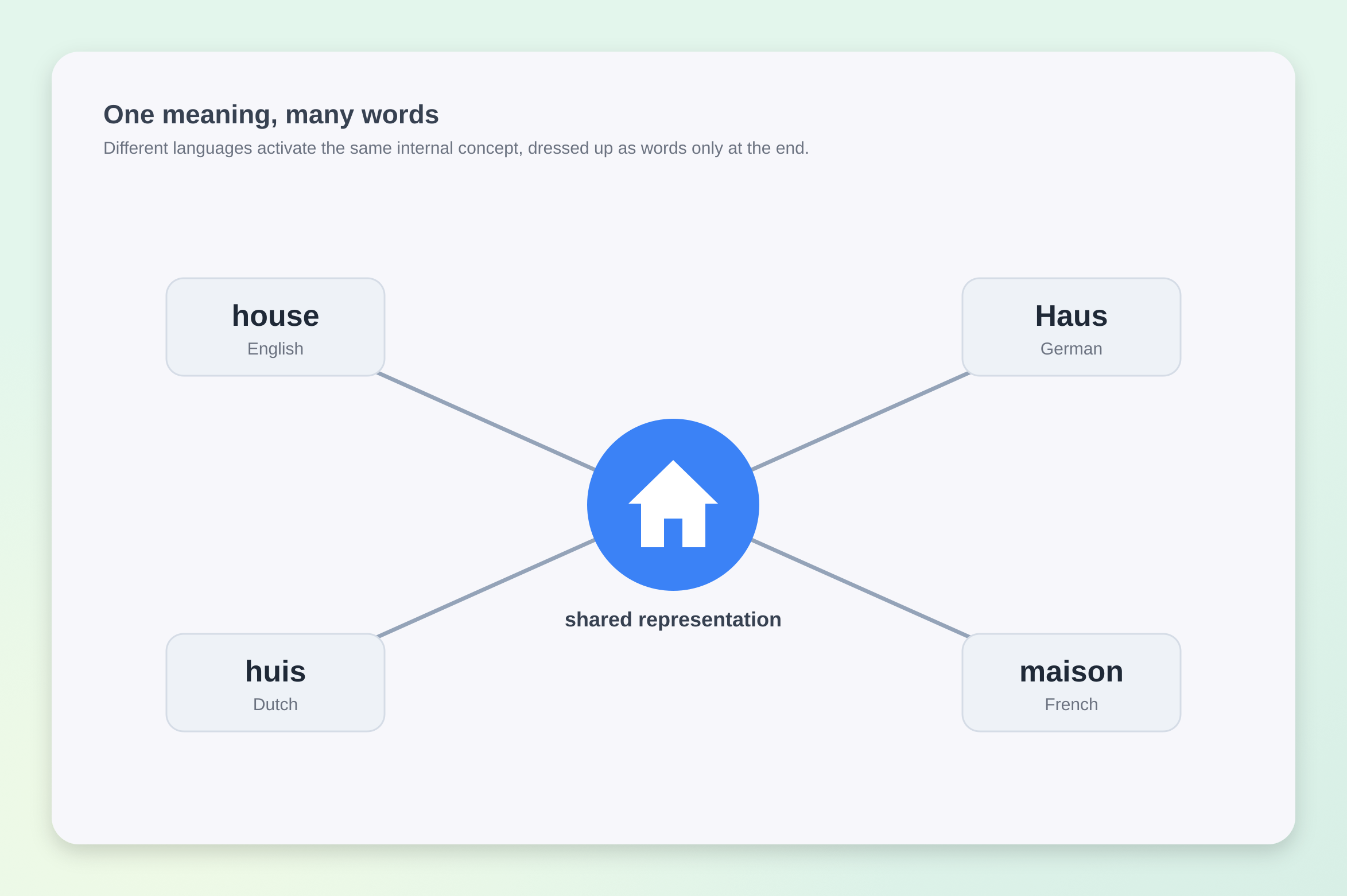
Why it happens is becoming clearer as scientists learn to look inside these models. Recent work that traces the internal circuitry of multilingual models has found that they form shared representations: the concept "dog," or "justice," or "yesterday," activates much the same internal machinery whether it arrives in English, German, or Japanese, with the language-specific dressing applied only near the output. English often acts as an internal meeting point, a pivot the model passes through on its way between other languages. In a very real sense, the model builds a space where meaning lives first and words come second. Once meaning sits in a language-neutral place, translating is less a special skill than a natural consequence of how the model thinks.
Why the output reads better
The mechanism explains the experience. Because attention reaches across an entire passage at once, modern models hold the whole context in view: a pronoun still correctly resolves to a name mentioned two paragraphs earlier, a verb agrees with its distant subject, and an ambiguous word takes its meaning from the surrounding sentences rather than from a dictionary's first entry. The old failure mode, where each sentence was translated in lonely isolation, is largely gone.
Just as important, a language model is a writer before it is a translator. It has absorbed the target language from libraries of well-written text, so its output carries the fluency, idiom, and register of something composed rather than assembled. It has also read your domain, whatever it is: manuals, contracts, medical papers, novels. Research on human-like translation strategies has shown that these models can even be guided through the same preparatory steps a professional translator takes, weighing keywords, topic, and context before committing to a rendering, which measurably reduces errors like mistranslation and omission. And for specialized work, fine-tuning or a handful of example translations shown in the prompt can adapt a general model to a particular company's terminology without retraining it from scratch.
Where LLMs still stumble
None of this means translation is a solved problem. The same training-data imbalance that makes English the internal pivot also makes quality uneven: languages with little text on the web are represented thinly in training, and translation involving them remains measurably weaker, as broad surveys of the field make clear. Performance is strongest when English sits on one side of the language pair, and it degrades for directions that skip the pivot. Even between major languages, evaluations across specialized domains find that quality dips as texts grow longer, denser in terminology, or further from everyday prose.
The deeper problem is how these models fail: silently. An older system announced its confusion with garbled output you could spot from across the room. A language model produces fluent, confident prose every single time, including the times it is wrong. A mistranslated technical term, a nuance that evaporated, a register that drifted from formal to chummy: each reads just as smoothly as a correct translation. The errors that remain are exactly the ones a reader cannot see without something to compare against.
The short answer
Large language models are good at translation because, at sufficient scale, understanding language and translating it turned out to be the same problem. Once a model builds a grasp of meaning that sits above any particular language, moving between languages comes almost for free. That is why we at Fink Translate build on the most powerful LLMs available: they are simply the strongest translation engines that exist.
And it is precisely because even the strongest engines make those quiet mistakes that Fink exists. Rather than asking you to trust a black box, Fink shows you the translation, every change along the way, and the why behind it, so a silent error becomes a visible one. You can read exactly how that works on our page about how Fink works. And if you are curious how hundreds of millions of people ended up translating with these models in the first place, we looked at the usage numbers separately.
Sources and further reading
The turning points recounted above rest on three classic papers: Sutskever and colleagues on sequence-to-sequence learning from 2014, Bahdanau and colleagues on the first attention mechanism, also from 2014, and Vaswani and colleagues' Attention Is All You Need from 2017, which introduced the transformer. For the multilingual side of the story, two surveys map the territory, Multilingual Large Language Models: A Systematic Survey and A Survey on Large Language Models with Multilingualism, while Tracing Multilingual Representations in LLMs offers a look at the shared internal circuitry described above. On translation quality specifically, Exploring Human-Like Translation Strategy with Large Language Models, published in TACL, inspired the passage about a translator's preparation, How Well Do Large Reasoning Models Translate? supplies the cross-domain evaluation, and Bridging the Linguistic Divide surveys the remaining challenges for low-resource languages. And if you would rather read one accessible explainer than a stack of papers, IBM's What is a Transformer Model? is the best single place to continue.